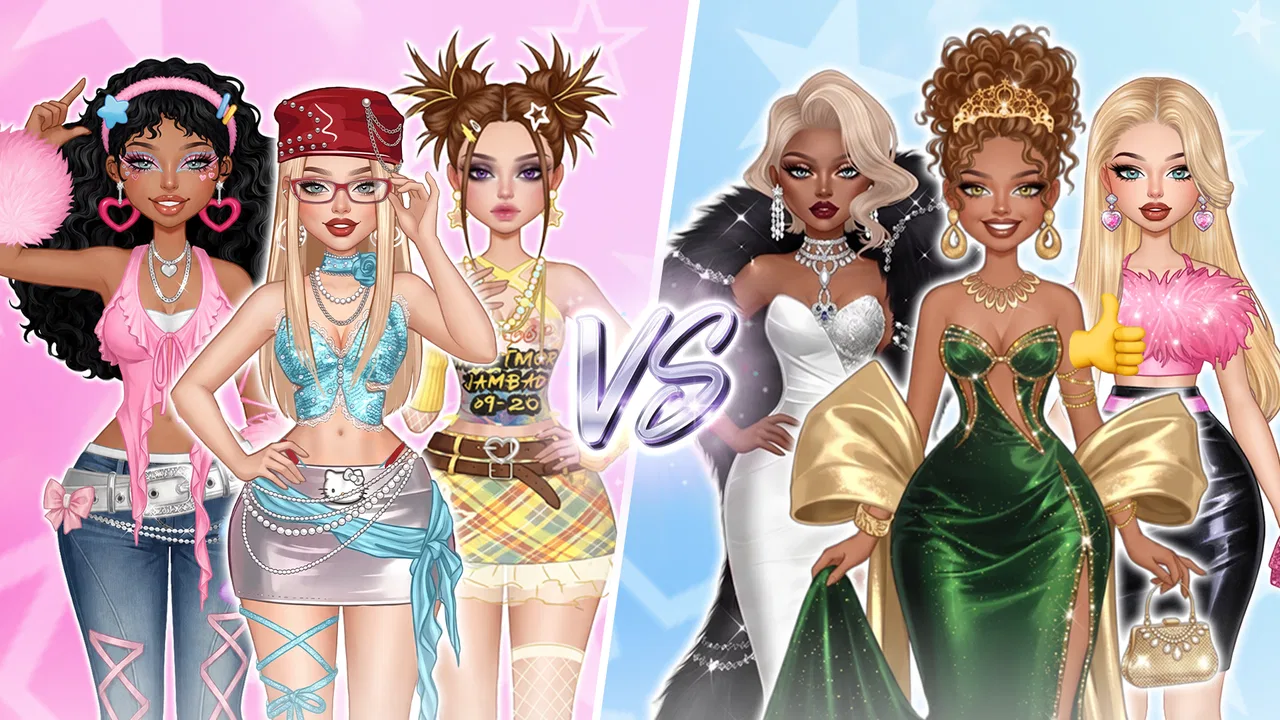
Rebel Glam: Dress Up Games
- 4.4
- Rating
- 10.00M
- Installs
- Free
- Price

 Analysis by App-foxy
I went into Rebel Glam: Dress Up Games expecting a quick avatar-styling diversion, and that is exactly where it works best. This is a free fashion simulation game from 31 Dress up Games, built around creative makeup, makeovers, and outfit decisions rather than a complicated story or demanding challenge. After spending time with it, I see it as a casual creative tool for anyone who enjoys experimenting with a digital look, especially when you want something light enough to play in short sessions.
The central appeal is easy to understand: you shape an avatar, adjust the overall appearance, and turn a basic character into a look with a stronger personality. The “Rebel Glam” identity gives the experience a more expressive direction than a purely conventional dress-up title. I found that useful because it encourages bolder combinations instead of making every outfit feel like it has to be polished, formal, or traditionally pretty.
It currently sits in the simulation category and is rated for Everyone, so the presentation is approachable for a broad audience. The game has an average rating of 4.5 from around 8.9 thousand ratings, with more than one million installs. Those figures suggest that its simple makeover format has found a substantial audience, although popularity alone does not make it the right choice for every player.
You May Also Like

 Blood Strike: 2.5 Anniversary
Blood Strike’s Loadouts Turn Every Drop Into a Tactical Gamble
A close look at Blood Strike’s custom loadouts: how fast access to signature weapons reshapes its battle royale rhythm, rewards preparation, and narrows the gap between fights.

 Pandora - Music & Podcasts
Pandora’s Music Is Easy to Start, but Harder to Recover
Pandora’s strength is its low-effort path from a seed to a station. Its weak spot is how much confidence it asks you to place in connection, setup, and quiet recovery.

 8 Ball Pool
 Is Built on Rivalries, Rematches, and Routine
A close look at the rivalries, rematches, shared routines, and unanswered safety questions that turn a quick pool match into a persistent mobile community.

 Samsung Music
’s Quiet Strength Is Playing What You Already Own
Its reach comes less from spectacle than from dependable access to a personal library. That simplicity is both the app’s strongest retention engine and its ceiling.

 AccuWeather: Weather Radar
AccuWeather Review: A Quick, Clear Forecast for Everyday Decisions
For everyday plans, the best forecast is the one you can understand quickly. AccuWeather makes rain timing, radar, and local conditions easy to act on, with a few trade-offs.

 Hill Climb Racing
Why Hill Climb Racing Still Turns Crashes Into One More Run
A tiny car, a bumpy hill and one more upgrade: Hill Climb Racing keeps resurfacing because its simple chaos makes every near-miss feel personal.
More From Our News Desk



How the current version feels to play
The first thing I noticed is how quickly the game gets to its main activity. There is no need to learn a complex ruleset before making progress. The experience is about choosing visual details and seeing how they work together, which makes it comfortable for a relaxed session. I could open it with no particular plan, try a different style, and stop without feeling that I had abandoned an important objective.
That low-pressure design is one of the strongest reasons to try it. Many simulation games ask you to manage resources, complete tasks, or maintain a long chain of progress. This one is more immediate. If I want a dramatic change, I can focus on makeup and the face. If I want a broader transformation, I can treat the avatar as a complete styling project and balance the appearance from head to toe.
The game is most enjoyable when I approach each makeover as a small design exercise. Instead of selecting the first attractive item in every category, I try to decide what the character is supposed to communicate. A rebellious look might benefit from contrast, while a glamorous look may need fewer competing elements. That simple habit makes the session feel more creative and helps prevent the familiar problem of dress-up games becoming a sequence of random taps.
I also appreciate that the premise does not demand a large time commitment. A player can use it as a short break between other activities, or spend longer refining a particular avatar. It is a good fit for people who enjoy visual customization but do not necessarily want a full fashion-management game with schedules, currencies, or strategic planning taking center stage.
Makeup works best when treated as the starting point
The makeup side is more interesting when it is used to establish the character before the clothes are chosen. I found that beginning with a mood—confident, theatrical, playful, or deliberately unconventional—made the later outfit decisions easier. Starting with clothing can work too, but it often leads to a look that feels assembled rather than designed.
My practical tip is to make one noticeable choice and then support it. If the makeup is already bold, I would avoid making every other part equally loud. If the outfit is the main statement, a more restrained face can keep the avatar readable. This is not a formal scoring strategy; it is simply the approach that produced more coherent results during my sessions.
That workflow is a useful distinction from many basic dress-up alternatives, where the objective is mainly to collect attractive pieces and place them together. Here, the makeover theme gives me a reason to think about the relationship between facial styling and clothing. The result is still casual, but there is enough room for personal taste to matter.
Small sessions, different kinds of players
For younger players, the Everyone rating makes the concept easy to approach, while adults may enjoy it as a calming creative activity rather than as a serious simulation. I would especially recommend it to someone who likes avatar creators, makeup experimentation, and fashion combinations but prefers a simple interface over a large social or competitive system.
It can also work well as a shared activity. A parent and child, siblings, or friends can take turns deciding the direction of a makeover and comparing the results. The most enjoyable version of that activity is not necessarily choosing the “best” look. It is setting a theme—for example, a stage performer, a night-out style, or an intentionally mismatched rebel—and seeing how each person interprets it.
On the other hand, I would not choose this game for someone looking for deep simulation mechanics, a substantial narrative, or a competitive fashion ladder. Its appeal comes from direct visual play. If you need long-term strategic progression or detailed character management, a larger fashion-management title will probably provide more substance.
What the release and current version tell me
The game was released on April 23, 2026, and the current version is 1.0.9. That places it in an early stage of its product life, so I view the present build as a foundation rather than a finished promise of everything the game might eventually become. The version number shows that the developer has already moved beyond the initial release, but it does not by itself tell me that major new systems have been added.
That distinction matters. I can judge the current makeover experience directly, but I would not buy into the game based on expectations of future wardrobes, tools, or modes. Those may arrive over time, yet they should be treated as possibilities rather than reasons to install today. Right now, the decision should depend on whether the existing styling loop already sounds enjoyable to you.
The early version also explains why I pay attention to friction that might become more visible as the game grows. A dress-up game needs a comfortable balance between creative freedom and a manageable number of choices. If future updates add more content, organization will become increasingly important. Categories that are easy to browse now could feel slower once the collection expands, so navigation is an area I would watch closely in later releases.
For existing users, the move to version 1.0.9 is best understood as evidence of ongoing maintenance rather than proof of a specific transformation. I would update because newer builds are generally the sensible way to use an actively maintained game, but I would not assume that the update changes the basic identity. The core experience remains a quick, accessible makeover game, and that consistency is valuable for players who already enjoy its rhythm.
There is also a practical point for people using older phones. The minimum operating system is Android 6.0, which keeps the compatibility requirement relatively accessible for devices that are not new. That does not guarantee identical performance on every handset, but it does make the game easier to consider if you are not using the latest phone. I would still leave enough storage and close unnecessary background apps if the device is older, especially before a longer styling session.
Where the free model affects the experience
The game is free to install, but it includes in-app purchases ranging from $0.49 to $24.99 per item. That range is important because the headline cost is not the whole ownership picture. I can begin without paying, which is helpful for testing whether the visual style and makeover loop suit me. At the same time, anyone who becomes invested in expanding or improving the experience should pay attention to purchase prompts and avoid treating optional items as necessary steps.
My advice is to play a few sessions before spending anything. In a game built around appearance, a single attractive item can create the feeling that more purchases are needed to complete a look. I would first learn how satisfying the available styling choices are on their own, then decide whether an optional purchase adds meaningful value for my personal use. This is particularly important when the player is a child and purchasing controls are shared with an adult.
The free-to-start approach is better for casual curiosity than for someone who wants every option immediately. If you enjoy making one or two avatars and moving on, the cost may remain irrelevant. If collecting and trying every visual possibility is the main attraction, the purchase range becomes a more significant part of the decision.
What feels distinctive and what still feels limited
The strongest distinctive quality is the combination of makeup-focused transformation and a more rebellious fashion mood. That gives the game a specific personality. It is not merely asking me to make an avatar look elegant; it invites experimentation with attitude. I found that direction more motivating than a neutral wardrobe exercise because it gave my choices a theme.
The limitation is that the experience is still dependent on the depth and variety of its available styling material. A dress-up game can feel fresh at first because every combination is new, then become repetitive if the player has seen the most appealing options too quickly. I would not describe that as a flaw unique to this title, but it is the main risk for anyone who expects a constantly changing game rather than a reusable creative playground.
Another trade-off is the lack of pressure. The relaxed structure makes it welcoming, but players who need clear goals may find it too open-ended. I sometimes enjoyed making a look simply because I liked the result; at other times, I wanted a stronger reason to continue after finishing one makeover. That difference between creative freedom and sustained motivation is worth considering before installation.
How it compares with familiar alternatives
Compared with a traditional avatar creator, this game feels more focused on the transformation itself. The makeup and makeover framing gives the player a sequence of visual decisions, rather than just a static character-building screen. Compared with a management-heavy fashion simulation, it is lighter and faster because it does not make planning, business decisions, or long-term resource handling the main attraction.
Compared with a social dress-up platform, it is the better fit for someone who wants private experimentation without needing interaction with a community to make the activity worthwhile. The trade-off is that a social alternative may offer more reasons to return, such as sharing, competition, or events. I would choose this game when I want direct styling; I would choose a broader platform when the social layer is the point.
It also differs from a makeup-only app because the avatar is not treated as just a face. The wider makeover concept lets me think about the complete presentation. That makes it more satisfying for outfit planning, while a specialized beauty app may be better if the user wants detailed cosmetic practice rather than character styling.
Who should install it and what to watch next
I would recommend this game to players who enjoy visual creativity, want an accessible fashion simulation, and are happy to create their own goals. It is particularly suitable for short breaks, casual experimentation, and shared theme-based play. The free entry point makes it easy to test, and the Everyone rating broadens its audience.
I would skip it if I need a story, complex progression, competitive rankings, or a realistic fashion career. I would also be cautious if I know that optional purchases make it difficult for me to enjoy a free game without chasing additional content. In that situation, a paid title with a clearly defined one-time cost may be a better match, even if it offers fewer ongoing additions.
For new players, I suggest using a three-pass workflow. First, choose the mood of the character. Second, select the strongest visual feature, whether that is the makeup or the outfit. Third, remove one choice that competes with that feature. This small editing step made my avatars look more intentional and gave each session a clearer purpose.
For returning players, the most useful thing to watch is whether future versions deepen the creative process without making it cumbersome. More options would be welcome, but only if they remain easy to browse and combine. I would also look for improvements that make repeat sessions feel different without turning the game into a demanding progression system.
My final view is positive but measured. Rebel Glam: Dress Up Games succeeds as a compact makeover experience with a clear attitude and an inviting learning curve. Its best moments come from making deliberate choices, not from rushing through every available item. The current version is worth trying if you want expressive avatar styling for free, provided you understand that its open-ended nature may not satisfy players seeking deeper game mechanics.
In everyday use, I can imagine opening it while waiting for an appointment, creating a themed look during a short break, and closing it once the avatar feels finished. That is a modest purpose, but the game serves it well. I would keep my expectations centered on creative dress-up rather than future promises, set sensible boundaries around in-app purchases, and give it a chance if the idea of turning makeup and clothing into a small visual design challenge sounds appealing.
FAQs for Rebel Glam: Dress Up Games
01What is Rebel Glam: Dress Up Games all about?
Rebel Glam: Dress Up Games is a fashion-centric app designed for those who love experimenting with styles and trends. Users can dress up characters with a wide variety of clothing, accessories, and makeup options. It offers a creative platform for fashion enthusiasts to unleash their style potential and enjoy a virtual makeover experience.
02What are the main features of Rebel Glam: Dress Up Games?
The app boasts a vast wardrobe selection, including modern and edgy clothing, a variety of accessories, and makeup tools. It allows users to save and share their styled looks with friends. Additionally, the app includes themed challenges and updates with new fashion items regularly, keeping the experience fresh and engaging.
03Is Rebel Glam: Dress Up Games suitable for all ages?
Rebel Glam: Dress Up Games is designed for fashion lovers of all ages, but it is particularly popular among teens and young adults. The app’s user-friendly interface and vibrant graphics make it accessible and enjoyable, while the content remains appropriate for a wide audience. Parents can feel comfortable with their children using the app.
04Does Rebel Glam: Dress Up Games offer in-app purchases?
Yes, Rebel Glam: Dress Up Games includes in-app purchases. While the app is free to download and play, users have the option to purchase additional clothing items, accessories, and makeup tools to enhance their styling options. This allows for a more personalized and expansive fashion experience.
05Can I play Rebel Glam: Dress Up Games offline?
Rebel Glam: Dress Up Games requires an internet connection for full functionality, including access to the latest fashion updates and challenges. However, some features may be available offline, allowing users to style and save looks without a connection. It's recommended to be online for the best experience.
Pros
- Extensive wardrobe options for creativity.
- User-friendly interface for easy navigation.
- Regular updates with new fashion items.
- Engaging storyline enhances gameplay.
- High-quality graphics for immersive experience.
Cons
- In-app purchases can be expensive.
- Limited offline functionality.
- Ads can interrupt gameplay flow.
- Requires a stable internet connection.
- Large app size takes up storage space.

Rebel Glam: Dress Up Games
Gallery